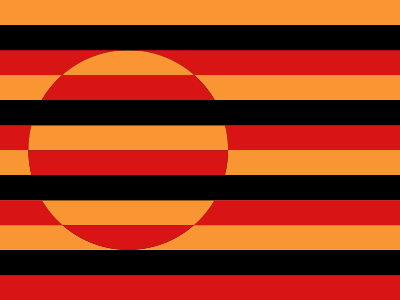
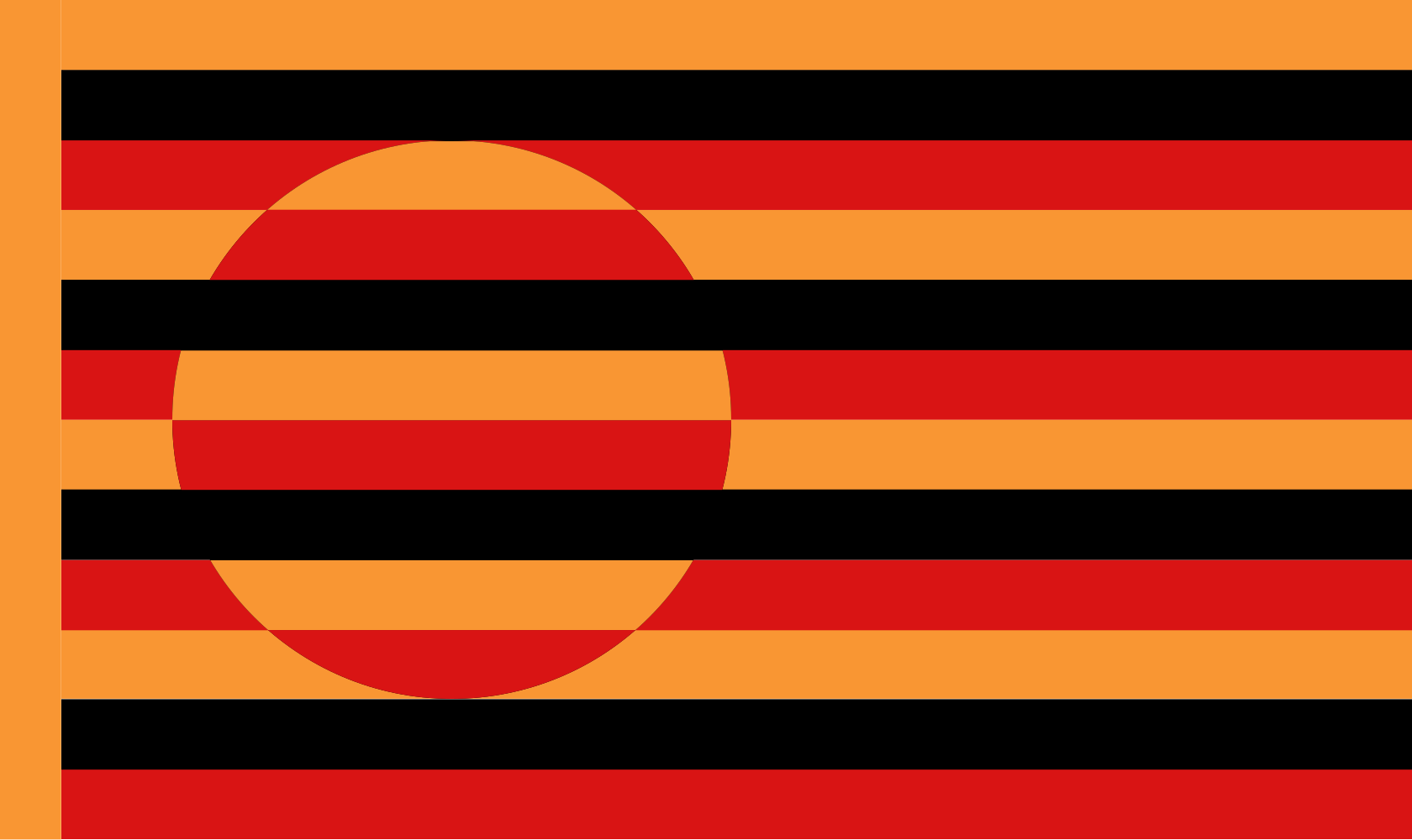
Java is a constituent republic of Verde Region.
| Java Republic | |
|---|---|
| Island of Sao Tome | |
| Constituent Republic of Vekllei | |
 |
|
| Part of the Verde Region | |
| Accession | 1945, as part of the British Atlantic Territories |
| Area | 859 km² |
| Capital | Java |
| Languages | English, Forro, Angolar, Principence |
| Population | 514,720 |
The Javan Republic is a constituent republic of Vekllei off the Atlantic coast of central Africa. Its sister republics, Principe and Annobon, are arranged to its northeast, and its closest continental neighbour is Latin Africa to its east. The three islands comprise the eastern grouping of the Verde Region.
Java is roughly oval in shape and its interior is dominated by tall volcanic mountains. The slopes of these mountains are heavily forested, and form microclimates of considerable biodiversity. The island is bisected by the equator, and is typically tropical and maritime.
The island was the site of the Portuguese colonial sugar economy in the 15th Century, which exploited enslaved African labour from Central Africa. The decline of this industry was supplemented by the expansion of the Portuguese slave trade. The rise of cacao production in the 19th Century coincided with the abolishment of slavery in Portugal, but it resulted in little practical improvement in the working conditions in the plantation system, which was dominated by indentured labour. The island was infamous for the brutality of its foreign and absentee plantation owners, and conditions only worsened upon Portugal’s entry into the Second World War. After the war, the islands were ceded to the UK, and working conditions saw some improvement.
Today, Java has had perhaps the most dramatic transformation in the postwar period. Although financial aid was common during the Atlantic Commonwealth period, the federal Vekllei system has invested heavily in infrastructure and education. The island is currently undergoing the process of federalisation, and has yet to transfer to the moneyless system of the rest of the country. Major land reform, and a sweeping urban renewal project managed by the Bureau of Public Works hopes to see Java reach near-parity with Verde Region by 2070.
Javan culture has deep roots in the lusophone African continent, and those bonds persist today. Although English is taught as a working language in schools, the majority language is Forro, a kind of Portuguese creole shared with other East Verde islands. The majority live in the capital, also called Java, where the cacao industry makes up the majority of exports. Under federalisation, the labour-intensive cacao plantation system is declining and being replaced by undersea hydrocarbons and utilities targeting the Central and West African markets.
Javans are mostly African or mixed-race, and are typically Roman Catholics. Many others come from the western islands of Verde Region. Soccer is unquestionably the national sport, and there are dozens of teams within Java. Passenger rail service has just started operation between the capital and the town of Ordella.
- Cement
- Chemicals
- Electronic Components
- Fish
- Glass
- Lubricants
- Palm Oil
- Petroleum
- Rare Earths
- Salt
- Timber
Climate
Equatorial and tropical, hot and humid year-round. Two rainy seasons and two drier periods cycle through the year. The volcanic interior creates distinct microclimates, with the mountains receiving substantially more rainfall than the coast.
Public Holidays
- New Year’s Day 1 Jan
- Carnival
- Good Friday
- Easter
- Commonwealth Day 1 May
- Corpus Christi
- Republic Day 12 Jul
- Assumption Day 15 Aug
- All Saints Day 1 Nov
- Christmas Day 25 Dec
- Obo National Park: Large national park within Java’s interior, most famous for the bizarre needlelike volcanic formation known as Great Dog.
- National Equatorial Monument: Monument and public park marking the site of the equator.
- Java Colonial Museum: Intimate and comprehensive museum of Java’s colonial history under Portuguese rule.
- Government Coffee Plantation: An historic coffee plantation dating back centuries, now under new management.
- Java Fleet Yard African Division 1,730
- East Atlantic Naval School African Division 2,110
- Atlantic Java Store Atlantic Department Company 280
- Java Plantation House Atlantic Hotel 30
- Java Works Atlantic Works 1,400
- Commonwealth Airways Java Base Commonwealth Airways 290
- Airlink Java Station Commonwealth Airways 85
- Veletia Lines Java Port Commonwealth Lines 350
- Java Railway CommRail 308
- Obo National Forest Railway CommRail 563
- Java Gulf Exchange Cosma 180
- Africa Federal Timekeeping 90
- Java Tropical Tea Fortune 400
- Java Atomic Plant General Reactor 130
- Java Guinea Forest Company Greenwood 550
- Method Tropical Works Method Heavy 700
- Naval Station Java