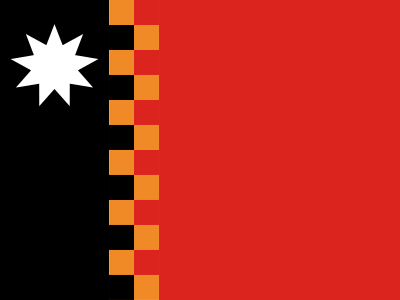
Sal is a constituent republic of Verde Region.
| Sal Republic | |
|---|---|
| Island of Sal | |
| Constituent Republic of Vekllei | |
 |
|
| Part of the Verde Region | |
| Accession | 1945, as part of the British Atlantic Territories |
| Area | 219.84 km² |
| Capital | Santa Maria |
| Languages | English, Verde Creole, Portuguese |
| Population | 54,494 |
The Sal Republic (literally “Salt”) is a constituent republic of Vekllei in the Atlantic, and is the northeasternmost island of the Barlavento archipelago. It comprises a main island shaped roughly like a fish and a tiny, uninhabited islet of its west coast. The republic is particularly flat and dry, and much of its surface is made of red, sandy dirt exposed to trade winds. It is fringed by pretty beaches of white sand, and receives an extraordinary amount of sun per year.
The island was sparsely populated throughout much of the early colonial period, but drew permanent settlement after the establishment of a salt works near the modern settlement of Pedra Lume. This spurred a “salt rush” that saw the island’s population grow rapidly. Other major settlements, including the capital of Santa Maria, are the legacy of the salt industry, which is mostly clustered around shallow, extinct volcanic craters. Although the industry saw significant decline during the 20th Century as major export markets were closed off by foreign protectionism, most of the major factories survive under municipal management in Vekllei, and the republic is the largest domestic exporter of salt in the country.
The history of the republic contributes to its unique appearance today. Its major towns, including the capital, are quite pretty Portuguese colonial settlements improved by irrigation of street trees and municipal agriculture in the federal period. Outside of these dense communities is a wide, flat expanse of land without any major features except for salt ponds, their factories, and aerial tramways that criss-cross the island with buckets full of salt. Outside of the cities and their gardens, the republic is mostly treeless and barren.
Santa Maria and the historic fishing village of Palmeira are particularly beautiful. The locals are a mix of local Verdeans and Persian migrants, mostly refugees from the first failed Jungle Coup in Iran. Persians are about half the population and practice culturally muslim traditions but are not especially devout. The salt industry is heavily automated, so most Salians work in research or academia.
There is a very pretty mosque in the capital, but the major attraction of the republic is the National Levantine Theological University (NLTU). This is a sprawling complex starting on the hilltop of Monte Curral in the centre of the island, and it cascades down its slopes to cover about forty acres. It is the largest theological institution in the country, with a special focus on ancient Abrahamic religious history (primarily Coptic, Roman Catholic, Syriac and Antioch Christians, Mizrahi Jews, Shia Islam, and Zoroastrianism). The modernist fusion style of its campus is particularly acclaimed, and unlike internationalist styles is heavily ornamented and decorated. It is among the most prestigious institutions of its type in the world, and has about 6,000 domestic and international students in addition to 3,000 permanent staff. Flowing water and canals characterise not just the NLTU but Santa Maria as well, and provide passive cooling.
Salians live in the handful of towns across the island, the largest of which is the capital. A lot of work is related to the NLTU in some way, either as writers, artists, academics or providing services like cooking or board for students. Despite their proximity to the university, they are typically sleepy towns with little nightlife. The salt works are the major export industry on the island, and fishing supplements the local diet. Their religion and customs are divided mostly evenly between the Verdean and Persian communities, which mix freely. Swimming in the salt craters are a popular novelty for resident students.
A train connects Santa Maria to the university, and proceeds onwards to the towns of Palmeira and Pedra Lume. The island is somewhat poorly connected by ferries compared to other Verde islands, lending the republic an insular quality. An airport is located just outside of Santa Maria, which accommodates international connections to the university.
Climate
Sal receives about 350 days of sunshine a year, and is among the sunniest places in Vekllei. The republic is hot and dry, and little rain ever falls.
Public Holidays
- New Year’s Day 1 Jan
- Heroes Day 20 Jan
- Republic Day 9 Mar
- Good Friday 30 Apr
- Commonwealth Day 1 May
- Ascension Day
- Whit Monday
- Assumption Day 15 Aug
- All Saints Day 1 Nov
- Christmas Day 25 Dec
- Adhesives
- Computers
- Electronic Components
- Fish
- Glass
- Palm Oil
- Paper
- Plastics
- Printing Ink
- Pulp
- Rare Earths
- Salt
- Semiconductors
- Santa Maria Beach: A stunning stretch of white sand and turquoise waters, popular among students at the NLTU.
- Buracona – Blue Eye: A natural pool with an underwater cave that creates a mesmerising “blue eye” effect when sunlight hits the water at the right angle.
- Pedra Lume Salt Crater Works: Large, operating salt works inside an extinct volcano, where visitors can float effortlessly in the saline waters.
- Our Lady Botanical Gardens: Large botanic gardens located near the capital, designed as an oasis among the sands.
- Shark Bay: Shallow bay where visitors can wade into the water to observe lemon sharks in their natural habitat.
- Port of Palmeira: The primary port on Sal, supporting cargo, fishing, and ferry services to other islands.
- The Sal Rei Palace Atlantic Hotel 70
- Roma House Atlantis 310
- Lucayan Section Bureau of Accreditation 100
- Office of Hydroponic Systems Bureau of Agriculture 780
- Office of Indoor Agriculture Bureau of Agriculture 640
- Office of Circuit Planning Bureau of Courts 380
- Office of Circuit Staffing Bureau of Courts 900
- Office of Remote Court Services Bureau of Courts 1,200
- Office of Local Economic Health Bureau of Economic Forecasting 460
- Office of Remote Community Support Bureau of Economic Participation 1,300
- National Health Archives Bureau of Health Services 340
- Oriental Industrial Area Bureau of Industrial Coordination 280
- Oriental Supply Area Bureau of Materials and Supply 580
- Office of Pollution Response Bureau of Oceans 520
- East Commonwealth Health Administration Bureau of Public Health 5,400
- Office of Immunisation Analysis & Renewal Bureau of Public Health 700
- Oriental Stewards Area Bureau of Stewardship 260
- Oriental Export Office Bureau of Surplus and Export 220
- Office of Nuclear Desalination Bureau of Water 1,400
- Sal Desert Cane Laboratory Caribbea Cane 400
- Airlink Sal Station Commonwealth Airways 50
- Veletia Lines Sal Port Commonwealth Lines 200
- Commonwealth Oil Central Control Commonwealth Oil 850
- Sal Central Railway Company CommRail 563
- Salt-Maria Line CommRail 294
- National Levantine Theological University National Levantine Theological University